
Here's something interesting about exceptional leaders: they don't get more feedback than everyone else. It's that they know what to do with it.
Most of us don't. Not really. We hear a hard truth about our leadership and quietly file it away as evidence about who we are. A tense conversation with a team member? Proof we're bad communicators. A project that flops? Proof we made the wrong call. And somehow, one critical comment can outweigh twenty things that went right.
Once feedback starts to feel like a verdict, curiosity walks out the door. Defensiveness walks in.
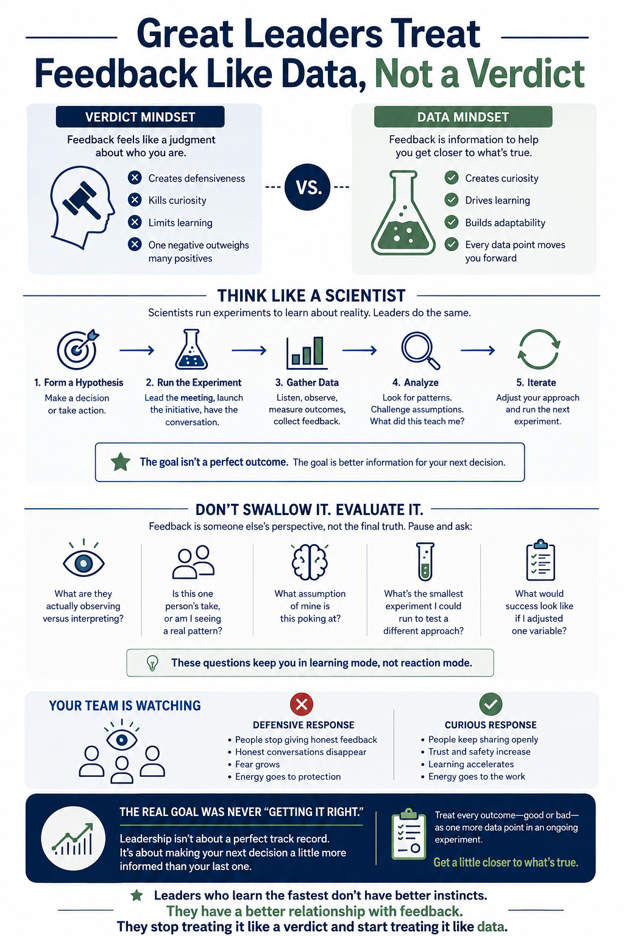
The best leaders don't play that game. They think more like scientists.
What scientists get that the rest of us forget
No scientist expects every hypothesis to hold up. That's not the point. The point is learning something true about the world. Every experiment produces data. Some of it confirms what they believed, some of it blows it up, and both outcomes move them forward.
Leadership works the same way, if you let it.
Every decision is an experiment. Every meeting generates information. Every new initiative, every hard conversation is all telling you something about your team, your communication, your assumptions. The real question was never "good outcome or bad outcome?" It's simpler than that: what did this teach me?
That one shift changes almost everything.
-
-
-
- Instead of "Was I a good leader?" try "What data did this give me?"
- Instead of "Who was right?" try "What actually happened?"
- Instead of "How do I defend this?" try "What do I adjust next time?"
-
-
But feedback isn't gospel either
Here's where a lot of leaders get stuck, and honestly, it's a fair place to get stuck. Feedback is rarely objective. It comes filtered through someone else's experience, priorities, and blind spots. That doesn't mean you toss it out. It also doesn't mean you swallow it whole as truth.
Good scientists don't rewrite their entire understanding because of one weird data point. They look for a pattern first. They test it. They gather more information before they conclude.
Do the same thing with feedback. Next time someone hands you a hard truth, sit with a few questions before you react:
-
-
-
- What are they actually observing, versus interpreting?
- Is this one person's take, or am I seeing a real pattern?
- What assumption of mine is this poking at?
- What's the smallest experiment I could run to test a different approach?
-
-
Questions like these keep you in learning mode instead of reaction mode. And that matters more than it sounds like it should.
Your team is watching how you handle this
Because here's the thing - they notice. If every bit of criticism is met with defensiveness, people stop bringing you criticism. If every suggestion feels like an attack, honest conversations quietly disappear from your team.
But when you meet feedback with curiosity instead, you send a different message: this is safe. This is useful. Do that consistently, and something shifts across the whole team - people stop spending energy protecting themselves and start spending it on the actual work.
The real goal was never "getting it right"
Leadership was never about a perfect track record. It's about making your next decision a little more informed than your last one.
The leaders who grow fastest aren't the ones who avoid mistakes - that's not even possible. They're the ones who treat every outcome, good or bad, as one more data point in an ongoing experiment.
Because in the end, leadership isn't about proving you were right.
It's about getting a little closer to what's true.

Holly Lewis is a U.S. Navy veteran and Performance Coach with a Bachelor’s in Computer Science, an MBA in Technology Management, and more than 30 years of executive experience, including with McKesson Corporation, a Fortune 100 company. Known as a corporate intrapreneur, she has launched three nationwide commercial software packages and led high-performing teams to deliver results under tight deadlines. Holly helps leaders accelerate execution while also protecting what often gets ignored in high-performance environments, which is executive health. With numerous advanced certifications, she provides practical strategies to prevent and recover from executive burnout while transforming how leaders operate. Outside of work, she supports The American Legion’s advocacy for veterans, enjoys time with family, vegetable gardening, and exploring historic West Virginia with her husband.